In work and management, not every task, customer, or problem creates the same level of value. Some factors may represent only a small proportion of the whole yet account for a large share of the results. The Pareto 80/20 Principle helps identify these high-impact factors, enabling individuals and organizations to focus their time, resources, and attention on what truly matters.
What Is the Pareto 80/20 Principle?
The Pareto Principle, also known as the 80/20 Rule, suggests that roughly 80% of outcomes come from 20% of the most important causes or inputs. For example, a business may find that most of its revenue comes from a relatively small group of customers, that most customer complaints stem from a handful of causes, or that the majority of a project’s progress depends on only a few critical tasks.
The 80/20 ratio is not a fixed formula that must apply in every situation. In practice, the distribution may be 70/30, 90/10, or something else entirely. What matters when applying the Pareto Principle is identifying the small group of factors responsible for a large share of the outcome and then allocating resources and attention accordingly.

Origins of the Pareto 80/20 Principle
The Pareto Principle originated from observations made by Italian economist Vilfredo Pareto in the late nineteenth century. In Cours d'économie politique (1896–1897), he observed that wealth and land tended to be concentrated among a relatively small proportion of the population, a pattern later commonly interpreted through the 80/20 ratio. At the time, however, Pareto was studying the distribution of wealth rather than productivity or management.
In the mid-twentieth century, quality management expert Joseph M. Juran extended this observation into management by demonstrating that a relatively small number of causes often accounted for the majority of quality problems. Later, Richard Koch further popularized 80/20 thinking through his 1997 book The 80/20 Principle, applying it to areas such as strategy, productivity, and personal development.
As a result, the way we understand the Pareto 80/20 Principle today reflects an evolution from Pareto’s economic observations to Juran’s management thinking and Koch’s broader applications.
How Does the Pareto 80/20 Principle Work?
The Pareto Principle begins with a simple question:
Which factors are creating the majority of the results?
Rather than giving equal attention to every task or problem, someone applying Pareto thinking collects data, evaluates the level of impact, and ranks factors according to their importance. This makes it possible to identify the relatively small number of causes or activities that generate the greatest impact.
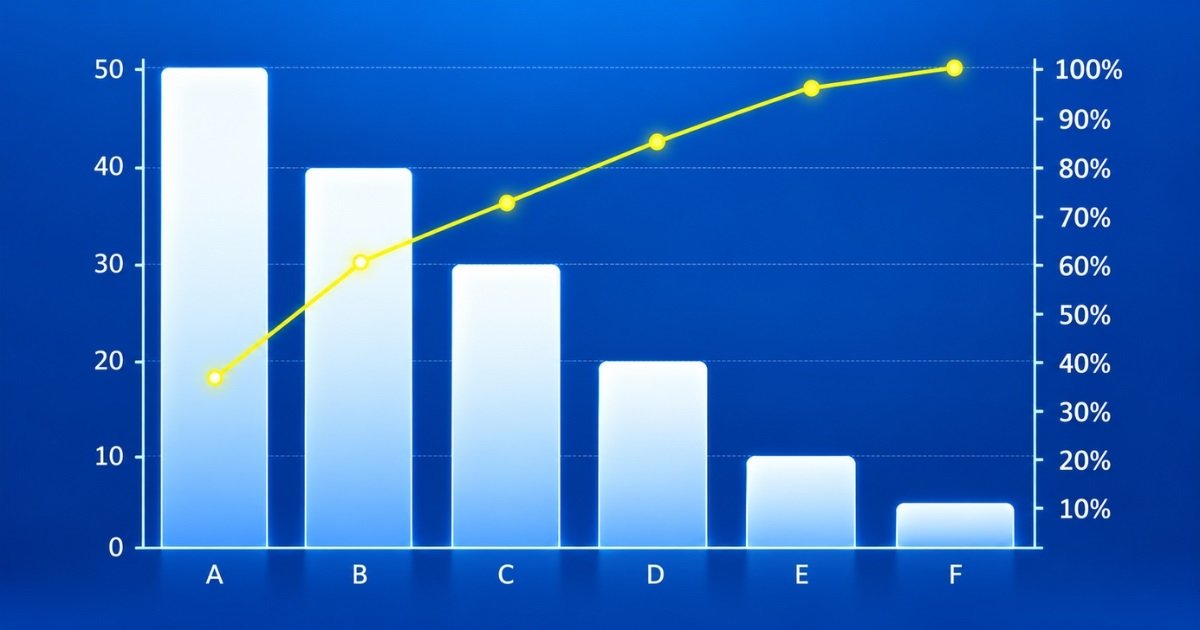
A Pareto chart is a powerful tool for organizing detailed data and helping managers identify the most significant factors affecting a result or problem. A Pareto chart typically includes:
1. X-Axis
The X-axis represents the categories being analyzed, such as causes of product defects, sources of customer complaints, reasons for declining revenue, or factors affecting productivity.
These factors are usually arranged from highest to lowest impact.
2. Y-Axis
The Y-axis shows the value or frequency associated with each factor, such as the number of occurrences, number of defects, revenue, cost, or another relevant measure.
This provides the basis for comparing how much each factor contributes to the overall result.
3. Bars
Each bar represents the value of one factor on the X-axis. The taller the bar, the greater the impact of that factor.
Arranging the bars in descending order from left to right makes it easier to identify which factors should receive priority attention.
4. Cumulative Percentage Line
The cumulative line shows the accumulated percentage contribution of the factors from left to right.
This allows users to see how much of the total outcome is accounted for by the first few factors and identify where resources should be concentrated.
5. Secondary Axis, If Applicable
The secondary axis is usually positioned on the right side of the chart and represents the cumulative percentage from 0% to 100%.
It is used together with the cumulative line to show how much each group of factors contributes to the total.
6. Other Elements
- Baseline: Provides a reference point for determining and comparing the height of the bars.
- Title: Identifies the issue being analyzed, the scope of the data, and the unit of measurement.
- Legend: Used when a chart includes multiple data groups, sources, or time periods, helping readers distinguish and interpret the information accurately.
Why Is the Pareto 80/20 Principle Important?
To execute effectively, the 4 Disciplines of Execution requires organizations to focus on the goals that matter most rather than spreading resources across too many priorities at once.
Under Discipline 1 — Focus on the Wildly Important — the Pareto 80/20 Principle can help leaders identify the activities with the greatest impact on their Wildly Important Goals (WIGs), allowing them to direct resources and attention toward the factors most likely to drive meaningful results.
1. Identify the Factors That Matter Most
Within a long list of tasks or problems, the level of impact can vary significantly. Pareto analysis helps identify the small number of activities, causes, or decisions that are likely to account for the majority of results.
This is particularly useful when an organization is facing too many priorities at once. Instead of trying to do everything, the organization can first focus on the factors that have the greatest impact on its goals.
2. Focus Resources on the Highest Priorities
Every organization operates with limited resources, including budget, people, and time.
If those resources are distributed evenly across every issue, the highest priorities may not receive the investment they deserve. Pareto thinking helps organizations shift from “doing more” to “focusing on the work that creates the most value.”
3. Improve Productivity and Work Effectiveness
A busy workday is not necessarily an effective one. Someone may complete dozens of small tasks while still failing to address the most important piece of work.
By identifying the activities that create the greatest value, individuals can devote their best time and energy to those activities first.
As a result, productivity is measured not only by how many tasks are completed but also by how much those tasks contribute to the desired outcome.
4. Support Better Decision-Making
The Pareto Principle offers an approach based on impact rather than intuition alone.
When choosing among multiple problems, projects, or opportunities, managers can ask:
Which decision is most likely to have the greatest impact on our goal?
This way of thinking helps simplify complex situations and provides a clearer basis for prioritization.
5. Reduce Wasted Time and Resources
Organizations may devote significant resources to issues that have relatively little impact. Pareto analysis helps identify areas where too much time is being spent for too little return.
By identifying the major causes behind a problem, organizations can also address issues at their source rather than repeatedly treating isolated symptoms.

Applications of the Pareto 80/20 Principle
Because it helps identify the factors with the greatest influence, the Pareto Principle can be applied in a wide variety of situations.
1. Time Management
Within a long task list, only a few activities may truly determine the outcome of a day, week, or project.
Applying Pareto thinking helps identify high-value tasks and prioritize them during the periods when an individual is able to focus most effectively.
For example, instead of beginning the day with emails and administrative work, a manager might first dedicate time to a strategic decision that is affecting the progress of the entire team.
2. Business Management
Businesses can use Pareto thinking to analyze products, markets, projects, processes, or sources of profit.
This helps organizations identify the areas that create the most value and those that consume significant resources while contributing relatively little.
However, Pareto findings should always be considered within a long-term strategic context. An activity that currently generates limited revenue may still be important if it builds capabilities or creates future growth opportunities.
3. Sales and Marketing
Sales teams can analyze which customer groups, products, or sales channels generate the majority of revenue.
Marketing teams can also identify which campaigns, content, keywords, or communication channels contribute most strongly to leads or conversions.
Resources can then be concentrated on higher-performing activities rather than spread too thinly across too many channels.
4. Customer Management
Not every customer has the same needs, potential, or long-term value.
Pareto analysis can help businesses identify the customer groups responsible for the greatest share of revenue, profit, or customer lifetime value.
The goal is not to ignore the remaining customers, but rather to design an appropriate level of service and resource allocation for each group.
5. Quality Management and Problem-Solving
This is one of the most common applications of the Pareto Principle.
When a process generates multiple types of errors, an organization can measure the frequency or impact of each cause and rank them from highest to lowest.
If a small number of causes are responsible for the majority of incidents, addressing those causes first will often produce the greatest improvement.
Pareto charts are commonly used in these situations to visualize the ranking of causes and their cumulative contribution.
6. Personal Development
Pareto thinking can also be used to evaluate which activities contribute most strongly to an individual’s development.
Someone might review which skills, habits, relationships, or experiences have the greatest influence on their career goals.
Rather than trying to improve every aspect at once, focusing on a few critical capabilities can create significantly greater progress.

How to Apply the Pareto 80/20 Principle Effectively
For Pareto analysis to genuinely support decision-making, it should be grounded in clear goals and real data rather than an attempt to force every situation into an exact 80/20 ratio.
Step 1. Define the Goal or Problem
First, clearly identify what you want to improve.
This could involve increasing revenue, reducing product defects, saving time, improving conversion rates, or addressing project delays.
The clearer the objective, the easier it becomes to identify the factors that matter most.
Step 2. List the Factors That Influence the Outcome
Next, identify the causes, activities, or factors that may influence the result.
For example, if the goal is to reduce customer complaints, possible causes might include late deliveries, defective products, inaccurate information, slow support, or a complicated return process.
Step 3. Collect and Analyze Data
Pareto analysis becomes more valuable when it is built on actual data.
Each factor can be measured by frequency, revenue, cost, time, number of defects, or another suitable metric.
The factors should then be ranked from highest to lowest impact.
Step 4. Identify the Factors Responsible for Most of the Outcome
Using the ranked data, determine which group of factors accounts for the largest share of the result or problem.
There is no need to force the analysis to identify exactly 20%.
What matters is recognizing the “vital few” factors whose impact is significantly greater than the rest.
Step 5. Prioritize Resources and Action
Once the key factors have been identified, the analysis must be translated into concrete action.
Determine which issues should be addressed first, where resources should be concentrated, and who will be responsible.
Pareto analysis creates real value only when prioritization leads to changes in how resources are allocated and used.
Step 6. Monitor and Adjust
The factors that matter most may change over time.
After implementing solutions, continue measuring performance to assess the results and determine whether the original priorities are still appropriate.
Pareto analysis should therefore be treated as an ongoing process of review and adjustment rather than a one-time exercise.
Example of the Pareto 80/20 Principle in Practice
Suppose a company receives 1,000 customer complaints in one quarter and categorizes them into five groups:
Cause | Number of Complaints |
Late delivery | 420 |
Product does not match description | 280 |
Difficulty contacting customer support | 140 |
Complicated return process | 100 |
Other causes | 60 |
The first two categories alone account for 700 out of 1,000 complaints, or 70%.
Rather than launching multiple improvement initiatives at the same time, the company could first prioritize improving its delivery process and the accuracy of its product information.
Common Misconceptions About the Pareto Principle
Applying Pareto thinking too mechanically can lead to poor decisions. Some common misconceptions include:
1. The Ratio Must Always Be Exactly 80/20
The 80/20 ratio is a way of describing an uneven distribution, not a mathematical law that applies to every situation.
In practice, the ratio might be 75/25, 90/10, or 65/35.
Data should never be manipulated simply to prove that an 80/20 relationship exists.
2. The Remaining 80% Can Be Ignored Completely
Identifying a group of high-impact factors does not mean that everything else has no value.
For example, a small group of customers may generate most of a company’s revenue, but the organization may still need to serve other customer segments to maintain market presence, develop future customers, or diversify risk.
3. Pareto Only Applies to Business
Pareto thinking can be used in any situation where it is useful to identify high-impact factors, from quality management and learning to time management and skill development.
The common requirements are a clear objective and the ability to evaluate how much each factor contributes.
4. Pareto Means Cutting Resources
Pareto does not mean simply reducing resources or doing less.
The principle helps organizations allocate resources more intentionally by prioritizing the factors that create the greatest impact.
In some cases, the analysis may even show that an organization needs to increase investment in a small number of critical capabilities to improve overall results.
When Should and Shouldn’t You Use the Pareto Principle?
Pareto analysis is particularly useful when multiple factors contribute to an outcome and there is a need to determine which ones should receive priority.
Examples include analyzing the causes of defects, allocating budgets, managing customer portfolios, selecting critical tasks, or improving a process.
However, Pareto should not be used as the only decision-making tool when a problem is systemic, when factors are highly interdependent, or when a risk occurs rarely but could have severe consequences.
For example, a rare safety incident may still deserve higher priority than more frequent issues with relatively minor impact.
The Pareto Principle should therefore be treated as a prioritization tool and used alongside risk assessment, strategic objectives, and the specific context of the decision.
Frequently Asked Questions About the Pareto 80/20 Principle
1. Is the 80/20 Rule Always True?
No.
The 80/20 ratio is simply a representation of the idea that a relatively small number of factors can account for a large proportion of results.
Actual data determines the specific distribution in each situation.
2. How Is Pareto 80/20 Different From the Eisenhower Matrix?
Both approaches support prioritization, but they use different criteria.
Pareto 80/20 | Eisenhower Matrix | |
Primary focus | Level of contribution or impact | Importance and urgency |
Key question | Which factors generate most of the results? | Which tasks are important, and which are urgent? |
Basis | Data and level of impact | Importance and deadlines |
Best suited for | Analyzing causes, resources, and effectiveness | Task and time management |
Outcome | Identifying the highest-impact factors | Deciding what to do, schedule, delegate, or eliminate |
The two approaches can also be used together.
Pareto helps identify which activities have the greatest impact, while the Eisenhower Matrix helps determine when and how those activities should be addressed.
3. How Can Pareto Be Applied to Time Management?
Start by reviewing the tasks completed over a certain period and identifying which activities contributed most directly to your most important goals.
Then prioritize those high-value tasks during the periods when you are able to concentrate most effectively.
The Pareto 80/20 Principle reminds us that not every effort creates the same amount of value. By identifying the factors with the greatest impact, individuals and organizations can improve focus, allocate resources more effectively, and make better decisions.
However, Pareto should be used as a data-driven prioritization tool rather than as a rigid formula applied indiscriminately to every situation.