Unclear strategic objectives contribute to more than 37% of project failures. Applying the SMART framework helps leaders and project managers define objectives that are specific, measurable, attainable, relevant, and time-bound. This creates alignment around action, strengthens progress control, and increases the likelihood of achieving the intended results.
What Are SMART Goals?
SMART is a goal-setting framework based on five criteria: Specific, Measurable, Attainable, Relevant, and Time-bound. It helps organizations translate broad directions into clear outcomes that can be tracked and implemented in practice.
For example, instead of setting a general goal to “increase revenue,” an organization could define the following SMART goal: “Increase revenue from corporate customers by 15% in Q4 2026 compared with the same period last year by generating 100 qualified leads per month.” This objective clarifies the desired result, the metric used to measure it, the priority customer segment, and the timeframe for completion.
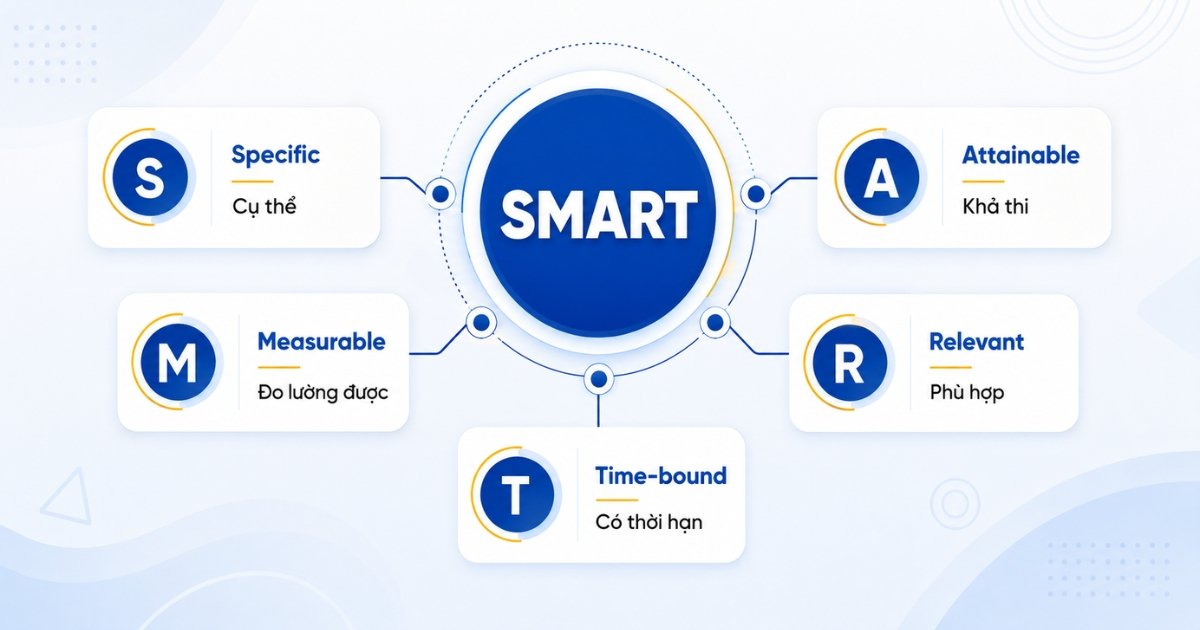
S = Specific
The objective should clearly describe the result the organization wants to achieve instead of relying on broad statements such as “improve performance,” “increase brand awareness,” or “enhance service quality.” A specific objective should answer the following questions: What needs to be achieved? Who is responsible? Which audience or area should be prioritized? How will the result be delivered?
M = Measurable
An outcome can be tracked and evaluated accurately only when it is linked to clear metrics. Depending on the objective, an organization may use revenue, profit, customer volume, conversion rate, processing time, satisfaction level, or task-completion rate as measures of success.
For example, the goal “attract more new customers” cannot be measured because it does not define how many customers qualify as “more” or which customers are considered relevant. A clearer objective would be: “Generate 500 qualified leads per month.” A specific number enables the team to monitor progress and assess performance accurately.
A = Attainable
An effective objective should be challenging enough to encourage the team to improve while remaining within its capacity to deliver. Attainability should be evaluated against financial resources, staffing, technology, time, data, delivery capability, and market conditions.
For example, if an organization currently generates an average of 400 qualified leads per month, increasing the target to 500 may be attainable with additional budget and a plan to optimize its marketing channels. By contrast, setting a target of 5,000 leads per month without increasing resources would create an unrealistic expectation.
R = Relevant
Relevance is determined by how closely an objective supports the organization’s strategy and most important priorities. An outcome may be specific, measurable, and attainable, yet still deliver limited value if it does not contribute to the organization’s broader direction.
For example, “Generate 500 qualified leads per month” would be relevant if the organization is prioritizing market expansion and revenue growth from new customers. Increasing social media followers would be less valuable if that metric does not generate leads or support a business objective.
T = Time-bound
A defined deadline gives the organization a clear endpoint for planning, allocating resources, and monitoring progress. For long-term objectives, weekly, monthly, or quarterly milestones can be established so that the team can review results regularly and adjust the plan when necessary.
For example, the objective could be completed as follows: “Generate 500 qualified leads per month throughout Q4 2026.” A specific timeframe helps the team determine the start date, completion deadline, and review milestones required during execution.
Why Should Organizations Use SMART Goals?
1. Translate Strategy Into Specific Results
Strategy defines an organization’s direction and priorities, but those priorities must be translated into clear objectives before they can be executed. SMART goals specify what needs to be achieved, the expected level of performance, and the deadline, while also establishing the criteria used to measure results.
Strategic objectives can then be broken down into relevant goals for each department, team, and individual. The organization also gains a basis for monitoring progress, evaluating completion, and making timely adjustments throughout implementation.
2. Create Alignment Across the Organization
When the destination is clearly defined, departments can build a shared understanding of the organization’s priorities and how each function should contribute. Marketing knows how many qualified leads it needs to generate, sales understands the conversion rate it must achieve, and operations can prepare the capacity required to deliver. This alignment reduces the risk of departments pursuing conflicting priorities or focusing only on their own functional goals.
3. Measure Performance More Accurately
Quantitative indicators enable organizations to monitor progress and evaluate results using data rather than subjective impressions. Managers can determine how much of an objective has been completed, which results meet expectations, and which performance gaps require improvement. SMART also helps distinguish between the volume of activity completed and the actual value created for the organization.
4. Strengthen Accountability for Execution
A specific objective with clear metrics and deadlines helps each individual or department understand its responsibility during implementation. Teams know which results they must deliver, what the completion standard is, and when the work must be finished. This reduces delays, avoidance of responsibility, and uncertainty about the causes of underperformance.
5. Allocate Resources More Effectively
Assessing attainability and relevance requires organizations to evaluate their resources carefully before pursuing an objective. Budgets, people, technology, and time can then be prioritized for activities that directly contribute to critical business results. This approach reduces fragmented investment, limits waste, and prevents teams from becoming distracted by too many objectives at once.
6. Identify Problems and Adjust in Time
Objectives with defined metrics and milestones help organizations detect gaps between planned and actual results early. If revenue, conversion rates, or implementation progress fall below expectations, managers can identify the causes and adjust their tactics before it is too late. SMART therefore provides a practical foundation for maintaining adaptability throughout execution.

Principles for Setting SMART Goals
For SMART goals to support execution effectively, organizations should begin with strategic priorities, define the intended outcomes, and clarify how performance will be evaluated. A well-designed goal should:
Start with a strategic priority: Each goal should contribute directly to an important direction, challenge, or business result.
Focus on outcomes: Describe what the organization wants to achieve instead of listing only the activities to be completed. “Launch a communications campaign” is an activity; “increase qualified leads by 20%” is an outcome.
Use clear performance measures: Define the metric, current baseline, and desired result so that progress and completion can be evaluated.
Balance ambition with feasibility: The target should be challenging enough to motivate progress while remaining appropriate for the organization’s resources, team capability, and market conditions.
Assign clear ownership: Each goal should have an individual or department with primary accountability, together with the supporting functions and a clearly defined scope of work.
Set deadlines and progress milestones: In addition to the final completion date, establish interim checkpoints to identify gaps early and adjust the plan.
Review and update regularly: SMART does not mean that a goal must remain unchanged under all circumstances. When business conditions change, the organization may adjust its approach or target based on data, provided that the change is transparent and consistent.
SMART Goals vs. OKRs
SMART and OKRs both help organizations translate direction into clear results that can be measured and tracked over time. Both approaches are designed to create focus, align priorities, and improve execution effectiveness.
| Comparison Criteria | SMART | OKRs |
|---|---|---|
| Purpose | Provides criteria for defining an objective that is specific, measurable, attainable, relevant, and time-bound. | Helps the organization establish priority Objectives and use Key Results to measure achievement. |
| Scope | Can be applied to goals at the individual, team, departmental, project, or enterprise level. | Usually deployed in alignment from the organizational level to departments, teams, and individuals to connect their efforts with business goals. |
| Structure and flexibility | Does not prescribe the number of goals or how they should be managed; each goal simply needs to satisfy the five SMART criteria. | Uses a defined structure consisting of Objectives and Key Results; the number is generally limited so teams can focus on the most important priorities. |
| Timeframe | Each goal has its own deadline based on the nature of the work or project. | Implemented in defined cycles, commonly quarterly, semiannually, or annually, with regular progress reviews. |
How to Set SMART Goals
1. Analyze the Current Situation
Before deciding on a destination, the organization should establish its starting point using reliable data. The analysis should cover current results, emerging trends, available resources, team capability, customer needs, and potential barriers to execution. A clear understanding of the context helps managers set objectives grounded in reality instead of relying on assumptions or subjective expectations.
2. Define the Desired Outcome
Based on the challenges and opportunities identified, the organization should select the most important result to achieve in the next period. This outcome must support a strategic priority, address a specific issue, or create clear value for the organization. Managers should also distinguish between activities and outcomes: an activity describes what will be done, whereas an objective describes the change the organization intends to create.
3. Refine the Objective Using the SMART Framework
The desired outcome should then be developed against the five SMART criteria: specific, measurable, attainable, relevant, and time-bound. At this stage, managers need to clarify the scope, performance measures, expected result, required resources, and completion date. A complete SMART goal should allow readers to understand immediately what must be achieved, how it will be measured, and when it will be considered complete.
4. Build a Detailed Action Plan
Once the objective has been established, the organization should translate it into tasks, milestones, and interim results. The plan should clearly identify who is responsible, which departments will collaborate, which resources will be used, the deadline for each workstream, and the dependencies between tasks. Breaking the objective into specific steps makes execution easier while providing a basis for monitoring progress and resolving emerging issues early.
5. Monitor, Evaluate, and Adjust the Goal
Progress should be reviewed regularly against the established metrics and milestones. When results fall below plan, managers should determine whether the cause lies in the tactics, resources, execution capability, or changes in the market before selecting the appropriate response. Organizations should prioritize adjusting the execution approach before changing the intended destination. If business conditions shift significantly, the goal may be updated, but the decision should be evidence-based and communicated transparently to all relevant stakeholders.

SMART goals provide a foundation for defining a clear destination, but results emerge only when objectives are translated into consistent action across the organization. Connect with FranklinCovey Vietnam to narrow the gap between strategy and execution through proven methodologies, build a disciplined execution system, and turn strategic objectives into measurable business results.