A growth mindset does not guarantee that every goal can be achieved through effort alone. Its core principle is the understanding that current ability is not a permanent limit. Through learning, practice, effective strategies, feedback, and appropriate support, people can make steady progress and expand what they are capable of achieving.
What Is a Growth Mindset?
A growth mindset is the belief that a person’s abilities are not entirely fixed and can be developed over time through learning, practice, and perseverance.
People with a growth mindset do not assume that they must be good at something from the beginning. When they encounter a difficult task or experience failure, they are more likely to ask, “What can I learn from this experience?” rather than, “Does this mean I am not capable enough?”
The concept of the growth mindset was developed by psychologist Carol S. Dweck and her colleagues through years of research into motivation, achievement, and how people perceive their own abilities. It was later introduced to a wider audience in Dweck’s 2006 book, Mindset: The New Psychology of Success.

Benefits of a Growth Mindset
1. Encourages Continuous Learning
A growth mindset helps people believe that their current abilities can improve through learning, practice, feedback, and adjustments to their approach. As a result, they are more likely to build the knowledge and skills they lack rather than treating their current limitations as final conclusions.
Learning also becomes more purposeful. Instead of stopping at the acquisition of information, learners consider how to apply what they know, evaluate the results, and improve their performance. Over time, small gains accumulate into new capabilities, enabling people to take on increasingly difficult and complex work.
2. Strengthens Adaptability to Change
Changes in technology, processes, markets, or job requirements can make previously effective experience and methods less relevant. A growth mindset helps people remain open to new knowledge, tools, and ways of working.
Rather than defending familiar methods, they are more willing to reassess the situation, identify the capabilities they need to build, and adjust their approach. This reduces overreliance on past experience and helps people prepare proactively for emerging demands.
3. Builds Resilience After Failure
A growth mindset helps people avoid equating a disappointing result with their overall worth or ability. Failure becomes a source of information that can reveal where a goal, assumption, method, or level of preparation needs to be adjusted.
This perspective helps people recover more effectively from unsuccessful experiences. Instead of remaining trapped in disappointment or self-doubt, they can focus on constructive questions:
- What led to this result?
- Which aspects are within my ability to change?
- What is the most important lesson?
- What should I do differently next time?
4. Improves Receptiveness to Feedback
When people are less preoccupied with proving that they are always right, they have more room to ask questions, consider different perspectives, and test new approaches. A growth mindset encourages them to view a problem as something to explore rather than as a test of their personal ability.
This makes problem-solving more flexible. People can actively examine their assumptions, take in new information, change their methods, and learn from experiments that did not succeed.
At the team level, this approach creates conditions in which members can share ideas, acknowledge what they do not know, and search for solutions together. Results that fall short of expectations can become valuable learning resources instead of being concealed out of fear of judgment.
5. Expands Career Development Opportunities
People with a growth mindset tend to invest proactively in the capabilities required for their next role. They are willing to take on new assignments, participate in challenging projects, and seek experiences that broaden their professional expertise.
Continuously updating their capabilities helps them respond more effectively to changing career demands. It also better positions them to assume greater responsibility, transition into new roles, or pursue new development paths. Career opportunities therefore depend on more than existing capability; they can also grow from a person’s ability to learn and turn experience into practical competence.
6. Fosters Team Development and a Culture of Learning
For managers, a growth mindset changes how employees are viewed and developed. Rather than assessing people solely on their current capability, managers consider their potential, readiness, and the experiences they need to continue growing.
This perspective supports team-development practices such as:
- Assigning work with an appropriate level of challenge.
- Providing feedback based on specific behaviors and results.
- Encouraging employees to experiment with new approaches.
- Creating opportunities to learn from mistakes.
- Recognizing progress and the ability to adapt.
- Building capability-based development paths.
When a growth mindset is reflected consistently in how work is assigned, feedback is delivered, performance is evaluated, and progress is recognized, teams become more open to learning and sharing. The organization also gains a stronger foundation for developing internal capabilities, building its succession pipeline, and adapting to new demands.

Characteristics of People With a Growth Mindset
People with a growth mindset believe that their current abilities can improve through learning, practice, and adjustments to their approach. This belief is reflected in how they respond to challenges, failure, and feedback in both work and life.
- They are willing to take on new and challenging assignments.
- They view mistakes and failure as opportunities to learn.
- They proactively seek knowledge, feedback, and support.
- They persist in pursuing goals while remaining willing to change their approach.
- They do not equate disappointing results with their ability or personal worth.
- They recognize progress throughout the process instead of focusing only on the final outcome.
- They learn from the success and experience of others.
- They use language that leaves room for development, such as “I cannot do this yet” instead of “I cannot do this.”
Growth Mindset vs. Fixed Mindset
A fixed mindset is the belief that a person’s intelligence, talent, or abilities are largely unchangeable. This belief can influence how people respond to challenges, failure, and feedback.
| Growth Mindset | Fixed Mindset | |
|---|---|---|
| View of ability | Can improve through learning and practice | Considered relatively fixed |
| Challenges | Opportunities to build capability | Risks that may expose weaknesses |
| Failure | Information that supports adjustment | Evidence of not being capable enough |
| Effort | A necessary part of the process | A sign of lacking natural talent |
| Feedback | Information for improvement | Personal judgment or criticism |
| Other people’s success | A source of inspiration and learning | A threat or source of comparison pressure |
| Goals | Learn, improve, and master capabilities | Prove one’s ability |
| Language | “I cannot do it yet” | “I cannot do it” |
| When results have not yet appeared | Reassess the approach and continue learning | Avoid, become defensive, or give up |
The key difference is not whether a person encounters difficulty. It lies in how they interpret that difficulty and choose what to do next.
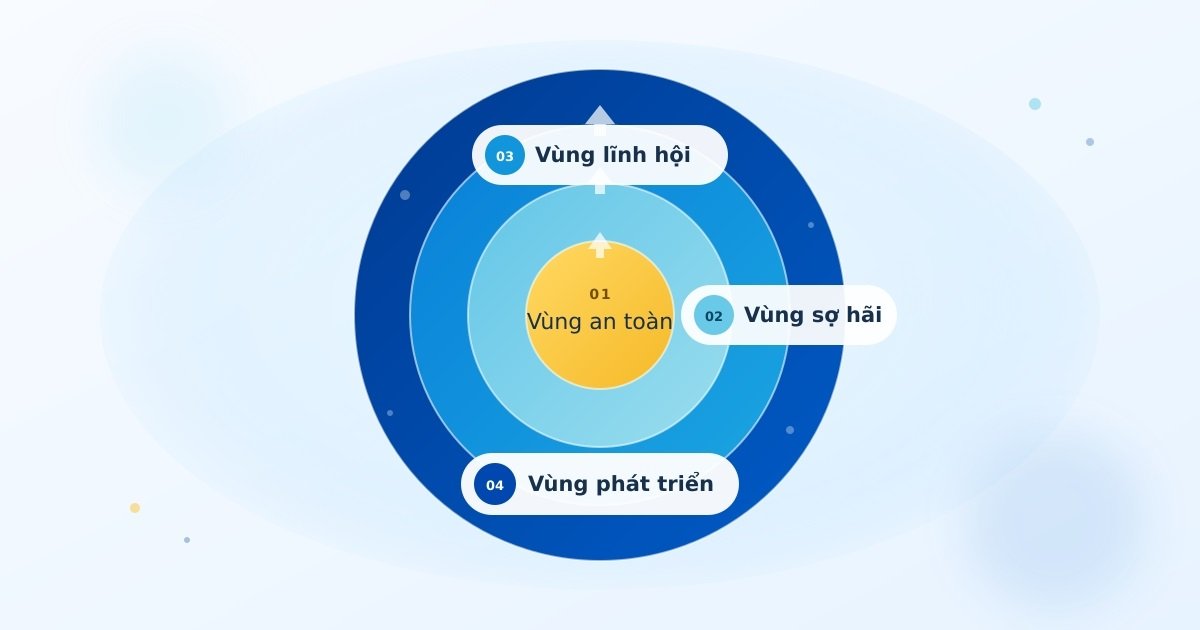
The Four Zones of Growth Mindset Development
The Comfort Zone
The comfort zone consists of familiar tasks, skills, and situations. People generally feel confident, experience less pressure, and have a relatively strong sense of control in this zone. The comfort zone is not inherently negative. It is where people can:
- Apply established capabilities with confidence.
- Maintain consistent performance.
- Restore their energy.
- Reinforce their self-confidence.
- Reflect on and consolidate experience.
However, staying in the comfort zone for too long can limit exposure to new demands. As the environment changes, capabilities that once worked well may gradually become insufficient. The issue is therefore not the existence of a comfort zone, but an unwillingness to leave it when necessary.
The Fear Zone
When people step beyond what is familiar, they often enter the fear zone, where uncertainty, anxiety, and doubts about their own ability begin to emerge. Common signs include:
- Fear of making mistakes.
- Concern about being judged.
- Comparing themselves with others.
- Finding reasons to delay action.
- Becoming defensive in response to feedback.
- Wanting to return to familiar ways of working.
Being in the fear zone does not mean a person lacks ability. It usually appears when a new demand extends beyond their current experience or sense of control. At this stage, a growth mindset does not mean feeling no fear. It means remaining able to act despite the fear.
To move through this zone, challenges should be broken down into manageable steps and supported by clear goals, appropriate resources, and the right level of assistance.
The Learning Zone
After moving beyond their initial hesitation, people enter the learning zone, where they begin to learn, experiment, and adjust. This is where growth becomes most visible through action. People may:
- Identify capability gaps.
- Acquire new knowledge and skills.
- Test different approaches.
- Proactively seek feedback.
- Analyze mistakes.
- Adjust how they work.
Gradually become more comfortable with uncertainty.
In this zone, failure is no longer viewed simply as evidence of “not being good enough.” It becomes information that helps identify what needs to change. This is also the point at which a growth mindset moves from belief to behavior: people believe they can improve and actively do the things that enable improvement.
The Growth Zone
The growth zone emerges when something that was once difficult gradually becomes a capability that can be applied with relative consistency. People complete the new task while also strengthening their ability to learn independently, self-correct, and adapt to future challenges.
Common signs of the growth zone include:
- New capabilities have been developed.
- Confidence has increased through practical experience.
- The ability to learn independently has improved.
- Feedback is translated into action.
- Situations that were once difficult can now be handled effectively.
- Previous limitations are reconsidered.
- There is a willingness to set new goals and take on new challenges.
The growth zone is not a final destination. Once a new capability becomes familiar, it may form part of a new comfort zone. A new challenge then emerges, taking the person back into the fear zone before they move once again through the learning and growth zones.
How to Develop a Growth Mindset
1. Reframe Failure
Failure often causes people to doubt their ability or interpret a disappointing result as proof that they are not suited to the task. Developing a growth mindset requires separating the outcome of one attempt from a person’s overall worth and capability. Instead of thinking, “I failed because I am not good enough,” consider whether the method, preparation, or initial assumptions may have been unsuitable.
After any result that falls short of expectations, take time to review the causes, identify what went well, and determine what needs to change. Failure creates value only when the lesson is translated into a specific action for the next attempt. This approach reduces self-judgment and redirects attention toward what can be improved.
2. Step Beyond Your Comfort Zone Deliberately
The comfort zone helps people maintain stability and make effective use of capabilities they have already mastered. Remaining in familiar work for too long, however, can limit learning opportunities and cause current capabilities to become less relevant as requirements change.
Stepping beyond the comfort zone does not mean choosing a challenge that is far beyond your capacity. Begin with tasks that are reasonably more difficult than what you can currently do, such as taking responsibility for a new area of work, leading a meeting, learning a new tool, or joining a cross-functional project. The challenge should be large enough to create learning while still offering clear goals, the necessary resources, and access to support when difficulties arise.
3. Focus on the Process and Purposeful Effort
The final result is an important measure, but outcomes are often shaped by many factors. When people focus solely on success or failure, they may overlook meaningful improvements in their capability, methods, and overall progress.
A growth mindset encourages attention to the quality of the process, including the level of preparation, the choice of strategy, persistence, and the ability to adjust. Effort, however, should not become an end in itself. When an approach is not working, change the method, seek feedback, or secure additional resources rather than continuing to repeat the same action. Progress usually comes from purposeful effort guided by a clear objective and continually adjusted in response to actual results.
4. Proactively Seek and Receive Feedback
Feedback helps people recognize blind spots that are difficult to see on their own. Instead of waiting for a formal performance review, proactively seek feedback from managers, colleagues, customers, or people with relevant expertise.
Questions should focus on specific behaviors and opportunities for improvement. For example, ask what is creating value, what is reducing effectiveness, and what single change would make the greatest difference next time. When receiving feedback, listen fully, request concrete examples, and separate feedback about the work from judgments about the person. Not every opinion will be relevant, but receiving feedback with openness provides additional information for consideration and improvement.
5. Replace “I Can’t” With “I Can’t Yet”
Language reflects how people perceive their own abilities. Saying “I can’t” can turn a current limitation into a permanent conclusion, whereas “I can’t yet” acknowledges reality while leaving room for growth.
Instead of saying, “I am not good at data analysis,” say, “I have not yet mastered data analysis.” The word “yet” should be followed by a next step, such as learning a foundational concept, finding a mentor, or practicing with a specific task. When supported by action, this change in language helps people move from self-limitation to proactive learning.
6. Recognize Progress Instead of Focusing Only on Results
Capability development often occurs through a series of small changes that can easily be overlooked when attention is fixed only on the final outcome. Recognizing progress helps sustain motivation and identify which approaches are working.
At the end of each week or project, take time to review what you have learned, which skills have improved, which feedback you have applied, and which tasks you can now perform better than before. Alongside outcome-based goals, track signs of progress in both behavior and capability. Recognizing the distance between who you are today and who you were in the past provides a stronger basis for continued growth and for choosing the next challenge.

A growth mindset begins when people view their current abilities as a starting point rather than a final limit. By learning proactively, receiving feedback, adjusting their approach, and persevering toward meaningful goals, they can gradually expand their capabilities and become better prepared for new challenges.
With leadership-development, personal-effectiveness, and winning-culture solutions implemented around the world, FranklinCovey Vietnam partners with organizations to turn mindsets into behaviors and measurable results. Connect with FranklinCovey Vietnam to explore the solutions best suited to your organization’s leadership, team, and culture-development goals.